
Our Extended Guide to the Realities of Piano Ownership
You've researched piano prices. Entry-level uprights cost $5,000. Professional models run $15,000. Baby grands start at $25,000. You've done the math, checked your budget, and you're considering whether you’re ready to buy.
Here's what nobody tells you when you're looking at that price tag.
After 50 years in the piano rental business, we've taken thousands of phone calls from piano owners. Not prospective buyers. Current owners who need to get rid of a piano they bought years ago. Some of them paid $15,000 for one they purchased only a few years before, that they're now trying to sell for $5,000. And they can't find a buyer.
Others are calling because they're moving to a smaller apartment and discovered that some professional piano movers want $700 just to move their upright across town. A few are dealing with pianos that haven't been maintained and would cost $5,000 to repair. The instrument has become an expensive, heavy problem.
The purchase price is just the beginning. Here's the complete picture of what piano ownership actually costs in 2026 and why renting might be the right choice for you.
The Purchase Price: What You'll Actually Pay
Let's start with what you already know you'll spend. Piano prices vary significantly based on size, brand, and quality tier.
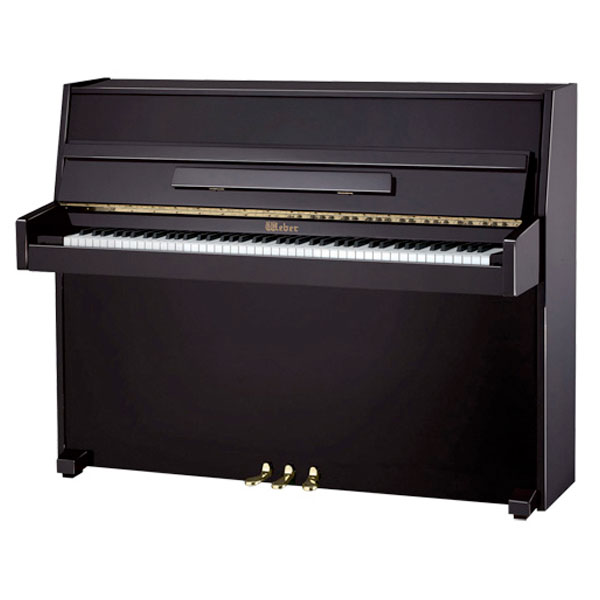
Console Pianos
Purchase: $3,000 - $5,000
Rent: $48 - 99/month
Studio Uprights
Purchase: $5,000 - $7,000
Rent: $68 - 145/month
Standard & Tall Uprights
Purchase: $12,500 - $30,000
Rent: $145 - 235/month
Baby Grand Pianos
Purchase: $12,000 - $35,000
Rent: $265 - 395/month
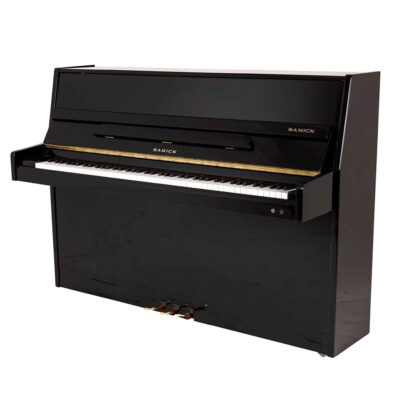 Console Pianos (43")
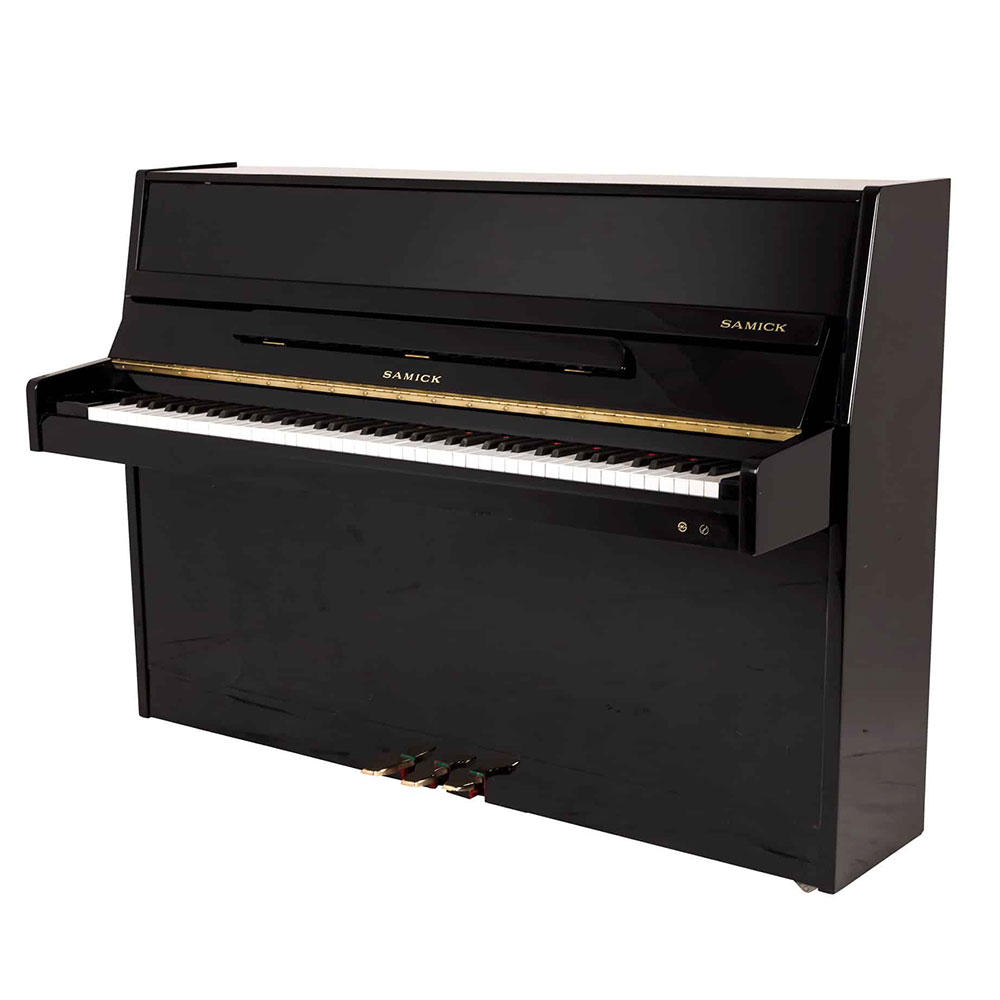
Purchase price: $3,000 - $5,000 / Rental: $48-$99 per month
These are the smallest uprights, standing 43 inches tall. The compact size offers real advantages: the smaller action is easier for small hands to press, the quieter sound won't overwhelm a small room or tire your ear, and the smaller cabinet navigates stairs and tight doorways more easily and allows you to place the piano in “unconventional” locations, like under a lofted bed in a child’s bedroom.
Brands like Young Chang and Weber offer quality 43" pianos suitable for students just starting lessons, adults learning as a hobby, and professionals who need a practice instrument in a space-constrained apartment.
All acoustic pianos with 88 keys are professional-grade instruments—the difference is how they fit your space and playing situation, not your skill level.
Studio Uprights (45-47")
Purchase price: $5,000 - $7,000 / Rental: $68-$145 per month
 Studio uprights like the Young Chang Y114, Y118 or Weber W-114 offer better sound quality and touch response than consoles. The footprint is the same as larger uprights (about 5' wide), but the shorter height means less volume—better for smaller rooms where a 48" or 52" piano would be overwhelming.
These pianos work well for advancing students and casual adult players who want better tonal quality without the power and projection of professional models. They also appeal to those who prefer the traditional upright aesthetic with front legs.
Brands like Young Chang, Pearl River, and Essex dominate this price tier. You're getting solid construction, decent soundboards, and responsive actions that can handle intermediate repertoire.
Standard & Tall Uprights (48-52")
Purchase price: $12,500 - $30,000 / Rental: $145-$235 per month (includes silent systems)
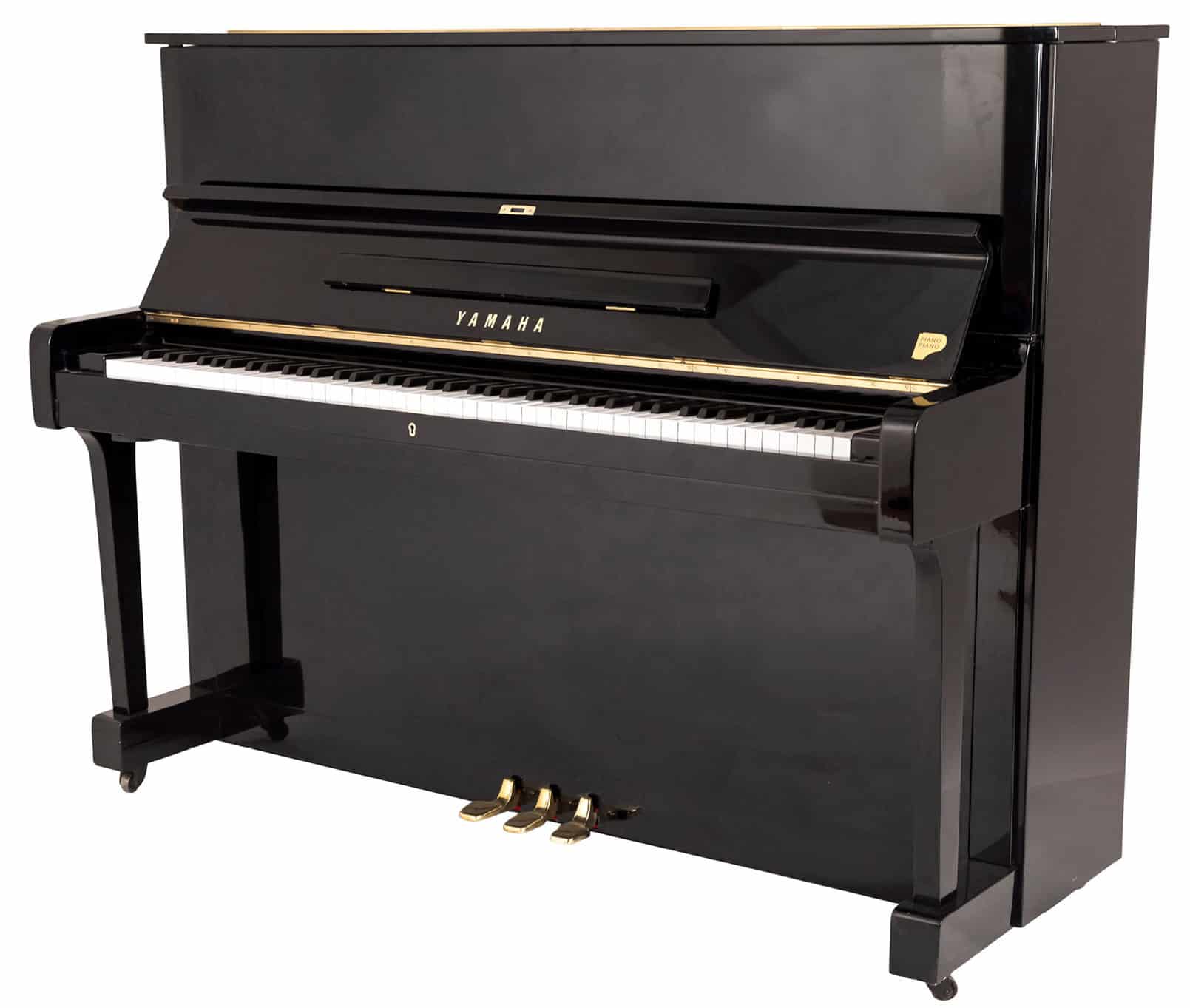 The 48" upright is the traditional standard size. The Yamaha U1—the world's most popular piano—is 48". The taller cabinet allows for longer strings and a larger soundboard, creating richer bass tones and more powerful projection. Young Chang and Yamaha models at this height have lighter, more responsive actions that work well for students building technique. Weber's 48" models feature heavier actions preferred by conservatory students building finger strength.
The 52" upright approaches baby grand dimensions in its action and sound. These are louder instruments with more demanding touch. They work beautifully for advanced pianists practicing for professional performance, but they're typically overkill for beginners or casual players—the sound can be overwhelming in smaller rooms. And you’re spending more than you need to if you're not a serious pianist, like buying a Mercedes to deliver pizzas.
High-end professional uprights from Steinway and premium Yamaha models can approach $30,000. Albert Weber models like the AW131—built with Renner actions and premium materials—deliver comparable quality for under $15,000. At this level, you're getting a concert-quality tone in an upright format.
Baby Grand Pianos (4’ 11” - 5’ 2”)
Purchase price: $12,000 - $35,000 / Rental: $265-$395 per month
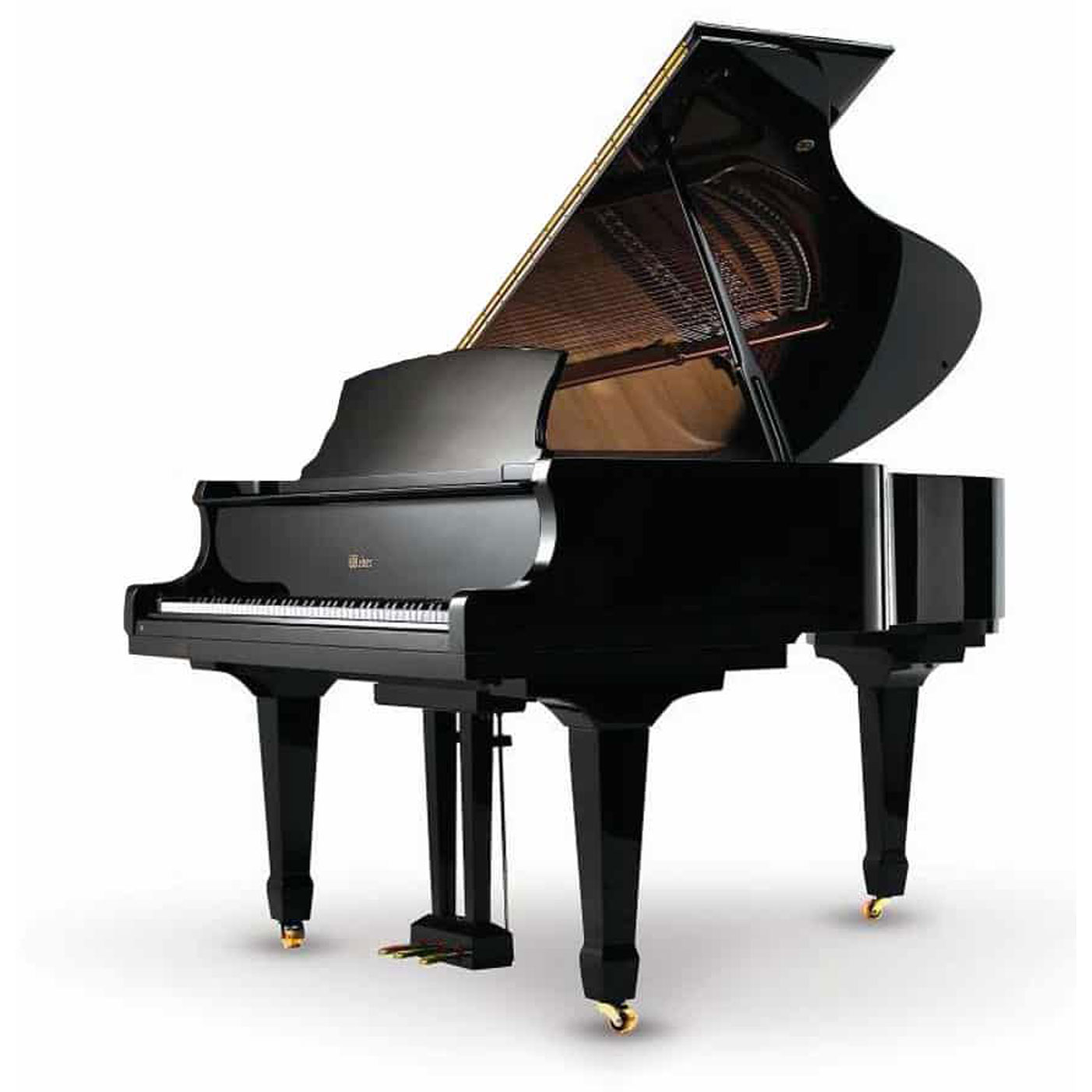 Baby grands start around $12,000 for models like the Young Chang Y-150 and Y152E and can exceed $35,000 for instruments like the Yamaha C3X. The horizontal string arrangement and larger soundboard create tonal depth that uprights can't match. PianoPiano also carries a Petite Baby Grand by Hardman & Peck that is 4' 8.”
But here's the reality: grands require significant floor space, and that's just the beginning of what they cost.
Used vs. New: The Quality Gamble
Used pianos cost 40-50% less than comparable new instruments. A $15,000 piano might be available used for $7,500. Sounds like a great deal, right?
The problem is you never know where that piano has been before or whether it was properly maintained. We get almost daily calls from people who bought a used piano that turned out to be a lemon. Maybe the previous owner lived in a humid climate and the soundboard cracked. Maybe they skipped tunings for five years and now the pinblock won't hold tension.
When we rent pianos at PianoPiano, every instrument comes from the manufacturer or a refurbishing facility. We know the full history because we've controlled it from day one. Every piano includes a 2-year warranty with an option to extend. You don't get that buying used from someone on Craigslist.
For a quick overview of current piano prices by type, see our shorter guide: How Much Does a Piano Cost in 2026>>
The Delivery Reality: The $400-$700 Gamble
Before you even get to delivery, there's the shopping experience itself. Piano stores aren't allowed to sell new pianos online—you have to visit showrooms, compare options, and haggle over prices. Every piano purchase involves negotiation. The price you see is never the price you'll actually pay. For many people, this is the worst part.
How many Saturdays do you want to spend driving to piano stores, playing the same models at different shops, trying to figure out who's giving you the best price?
So you've found the perfect piano and negotiated the price. Now you need to get it home.
[IMAGE: Piano movers carefully navigating a piano up a narrow staircase, showing the difficulty and teamwork required. Documentary-style photo. Alt text: "Professional piano movers carrying upright piano up apartment building stairs"]
What Piano Delivery Actually Costs
When you buy a piano from a retailer, delivery is usually included in the purchase price. They're factoring that $400-$700 cost into their margin.
If you're buying from a private seller, you'll pay:
- Upright piano: ~$400
- Grand piano: ~$700
- Additional for stairs: $50-$150 per flight
- Difficult access: Additional $100-$300
That's for professional movers who know what they're doing. And trust us, you want professionals.
 The Horror Stories We Hear
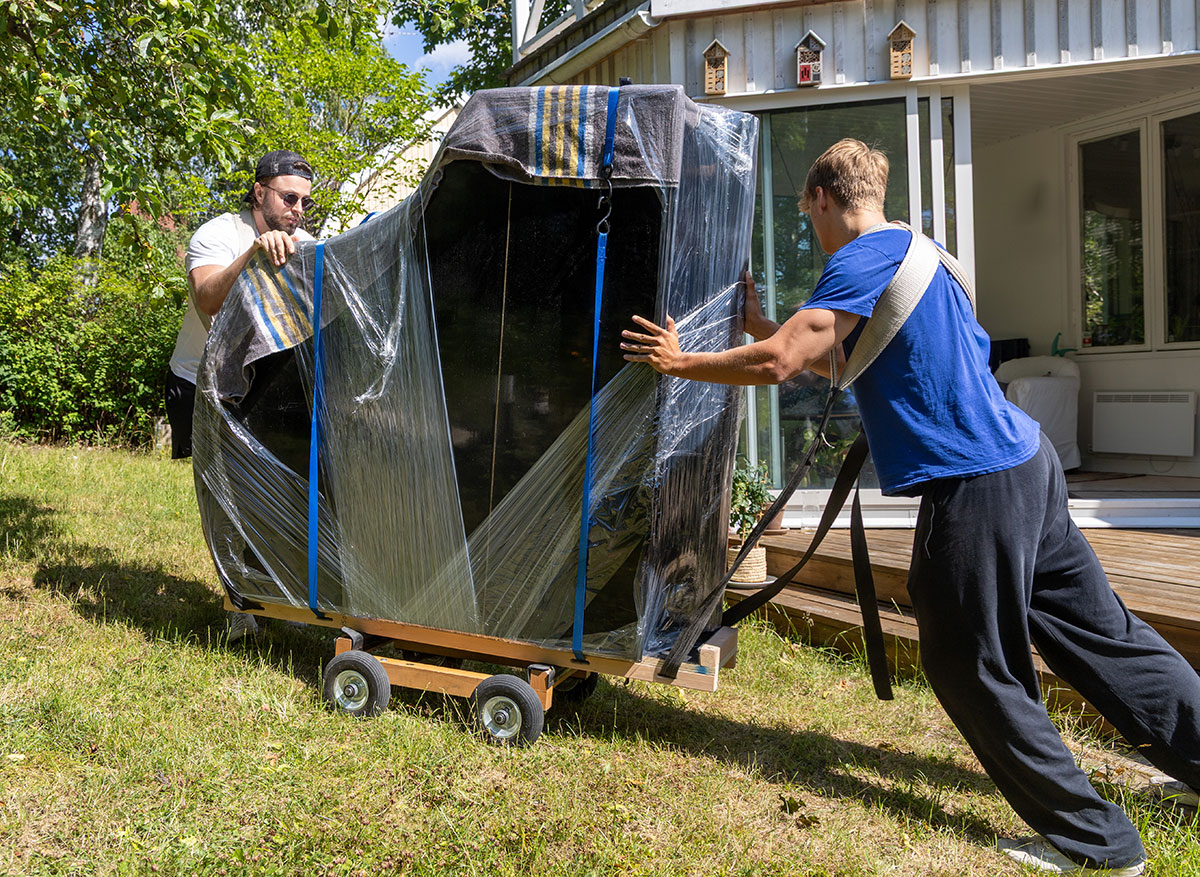
We've seen everything over 50 years. Here are real situations from customers who called us:
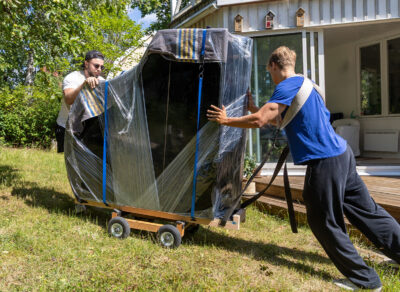
The sidewalk piano: Movers the customer found on Craigslist showed up with a pickup truck. When they encountered stairs, they simply left the upright piano on the sidewalk and drove away. The customer had to hire emergency movers at premium rates and the piano sat outside overnight!
The destroyed hallway: DIY movers who didn't know how to navigate a piano through tight turns. They scraped paint off walls, gouged the hardwood floor, and dented the piano itself trying to force it around a corner. The repair bills exceeded what professional movers would have cost.
The dropped piano: Moving a piano isn't like moving a couch. The weight isn't evenly distributed, and you need specific techniques to handle the instrument safely. We've heard from people whose friends dropped their piano, causing internal damage that wasn't immediately visible but made the piano unplayable within months.
This is a huge, heavy instrument. An upright piano weighs 300-500 pounds. A baby grand weighs 500-800 pounds. You could get seriously injured trying to lift it yourself, and the piano itself could be irreparably damaged.
A Word About Professional Movers
Professional furniture movers are not specialized in the transport of pianos. Just because they can move your house contents doesn’t mean they know how to transport a piano. You should always use a dedicated piano mover and not trust a furniture moving team.
Here's what makes piano delivery expensive: Half of our customers face difficult delivery situations.
- Flights of stairs without an elevator
- Tight elevators that require turning the piano on its side
- Sharp turns in hallways that require specific angling techniques
- Narrow doorways that need the piano to be tilted or partially disassembled
- Low-clearance ceilings in older buildings
- Long carries from the truck to your door
PianoPiano’s professional, dedicated piano movers account for all of this. Your cousin with a truck does not.
Another issue that can come up in apartment buildings is insurance. Most buildings now require movers to provide a COI and high end buildings require millions of dollars of insurance coverage. If you find a random local mover, they may not even be allowed into your building. We are the only piano movers that are qualified to move pianos at the Freedom Tower and to a fifth floor walk up.
When you rent from PianoPiano, delivery is included in your first payment, and we handle all the complexity.
We have been doing this for decades, serving an over 73-million person market across the Northeast corridor and Southern California, from Boston to Washington D.C., and throughout Southern California.
(We deliver to the suburbs too! if you don’t see your city or town here, contact us, we’ve probably been there.)
Northeast Service Area:
- New York (see our Manhattan showroom!)
- Long Island
- Connecticut
- New Jersey
- Rhode Island
- Western Mass
- Albany
- Finger Lakes
- Catskills
- Boston
- Philadelphia
- Baltimore
- Washington D.C.
- Everywhere in between
Southern California Service Area:
- Los Angeles County
- Orange County (see our Fullerton showroom!)
- San Diego County
- Santa Barbara
- Ventura
- Riverside
- San Bernardino
- Palm Springs
- Basically anywhere in Southern California.
And to apartments, venues, and homes like yours. We know how to protect your home and the instrument.
Need a piano quickly? We can often deliver within 24-48 hours in our core service areas. Unlike buying from a private seller where you'll wait days or weeks to coordinate movers, we have the logistics infrastructure to get a piano to you when you need it—even if your child's first lesson is this week.
Maintenance: The $500/Year Reality
You've bought the piano and gotten it home. Now you need to keep it playable.
Annual Maintenance Costs
First of all, and not shown here as a distinct cost, you have to find a tuner. How do you know who is good and who taught themselves on youtube? All of our technicians are vetted by our company so you can trust who is coming in to maintain your instrument.
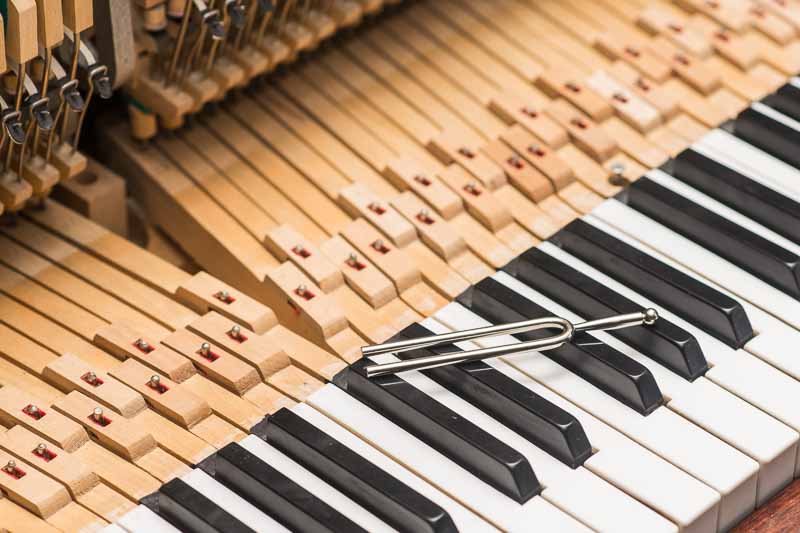
Market rate: ~$500 per year
This breaks down to:
- Two tunings per year: $150-$250 each = $300-$500 annually
- At PianoPiano: We charge $175 per tuning ($350 annually in Manhattan)
Our locally-based rates are lower because we supply professional tuners with volume.
Why twice a year? Pianos are made from eight different kinds of wood that expand and contract at different rates as temperature and humidity change. If you live somewhere with real seasons, your piano goes out of tune as the weather shifts.
Additionally, in certain areas we offer a tuning plan that lets you pay $25 per month toward your required tunings, rather than paying the full $175 twice a year--if you do the plan, the tuning only costs $150 so you also save $25 per tuning. This spreads the cost and ensures your piano stays properly maintained.
When Maintenance Gets Expensive
If you don't maintain your piano properly, you're looking at serious costs:
Regulation and voicing: $300-$800 The action mechanism (the parts that make the hammers strike the strings) needs periodic adjustment. Voicing shapes the tone by adjusting hammer hardness. These aren't yearly expenses, but they're necessary every few years.
Minor repairs: $100-$500 per incident
Broken strings, worn hammer felts, sticky keys, pedal issues. Small problems that need addressing.
Major repairs: $1,000-$5,000+ Here's where poor maintenance catches up with you. If the piano becomes untunable because the pinblock is shot, you're looking at $5,000+ to replace it. If the soundboard cracks due to humidity problems, the repair might cost more than the piano is worth.
With a rental, you skip all of this. We make sure you get your piano tuned at a discounted rate—and we'll remind you when it's due, so you don't have to remember. If something seriously goes wrong with the piano, it's our piano. We'll exchange it for you. You never face a $5,000 repair bill on an instrument you're still trying to decide if you want to keep.
The Warranty Problem
A lot of people don’t know that not maintaining your piano properly usually voids the manufacturer's warranty. If you bought a $15,000 Yamaha and skipped tunings for two years, good luck getting warranty service when something breaks.
We include maintenance reminders as part of our rental service. After six months with a rented piano, we schedule your tuning with our certified technicians. No searching for someone qualified, no worrying if they know what they're doing. We make it easy because we want the instrument to stay in good condition. It's in our interest and yours, and you get back to playing.
Depreciation: The Truth Nobody Wants to Discuss
This is where the math gets uncomfortable.
 Pianos Depreciate Like Cars (But Worse)
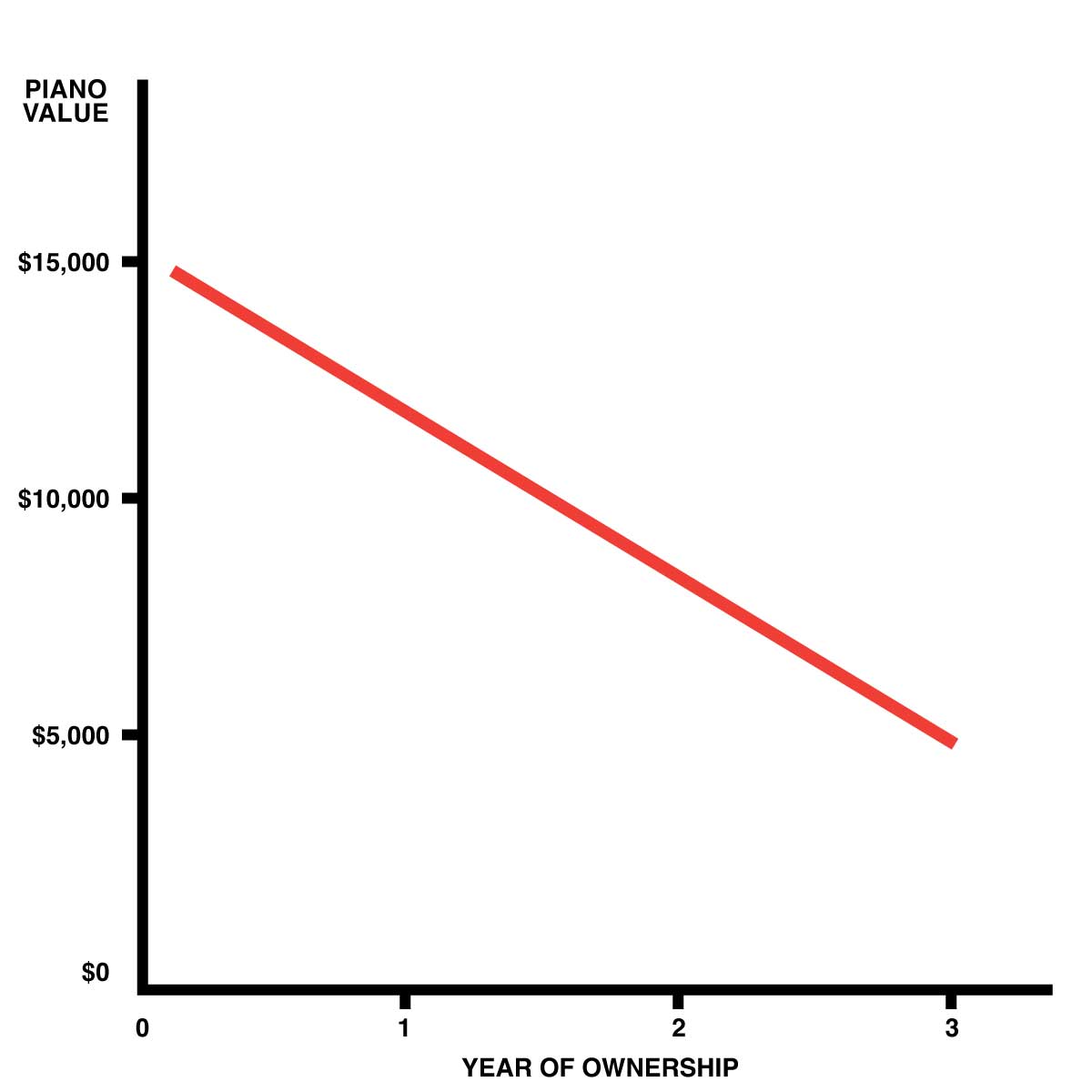
Average depreciation: 66% over 2-3 years
That $15,000 piano you bought? In three years, you might be able to sell it for $5,000 on the private market. If you can find a buyer at all.
Let's be specific. You purchase a mid-range Yamaha upright for $15,000. Three years later, you need to move to a smaller apartment, or your child quits piano lessons. You list it for sale at $10,000, thinking that's reasonable, but no one’s interested. Crickets.
You drop the price to $7,500. Still nothing.
Finally, at $5,000, you get some interest. But buyers want to negotiate. They want you to include free delivery. Some want you to hold it for three months while they figure out their moving situation.
If you're short on time (because you're moving or downsizing), you have two options:
Option 1: Sell to a piano store. They might offer you $2,500 so they can resell it for $5,000.
Option 2: Try to sell it yourself and hope you find a buyer before your moving deadline.
This is not a good asset to own.
When you rent, you never have to worry about this. Just send us an email with 30 days notice and we'll come pick it up. You already paid for the pickup at the beginning, so there are no surprise costs. A piano when you need it, and not when you don't.
Why Pianos Depreciate So Heavily
Unlike real estate or certain collectibles, pianos don't appreciate. They're depreciating assets from the moment you buy them. Here's why:
Supply exceeds demand. Lots of people buy pianos. Fewer people want to buy used pianos. The market is flooded with instruments from people who thought they'd use them more than they actually did, or inherited them from somewhere, and on and on.
Maintenance uncertainty. Buyers don't know if your piano was properly maintained. Even if you swear you tuned it twice a year, they have no way to verify that. They're taking a risk.
Moving costs. Any potential buyer knows they'll need to pay $400-$700 to move your piano to their home. That's a built-in discount they expect.
Condition degradation. Unless you controlled humidity perfectly, your piano has experienced some wear. Felt compresses. Strings age. Wood settles. It's not the same instrument it was when new.
The Worse-Than-A-Car Comparison
People joke about cars losing value when you drive them off the lot. That's real, but at least you can usually find a buyer for a car. There's an entire infrastructure (CarMax, dealers, Craigslist, etc.) designed to help you sell vehicles.
No such infrastructure exists for pianos. There's no Piano Max, and dealers aren't eager to buy your used instrument. The market is thin, and you're on your own.
Even if you find interested buyers, you're sending a million pictures, answering detailed questions, then scheduling times for them to come examine the piano—maybe more than once. You're letting strangers into your home to view and play the instrument. It's time-consuming, uncomfortable, and still no guarantee they'll actually buy.
The Resale Nightmare: "We Get Calls Every Single Day"
 This is the hidden cost that nobody talks about until they're living it: what do you do with the piano when you're done with it?
The Daily Reality at PianoPiano
We get calls and emails every single day from people who want to sell their piano to us. Every. Single. Day.
We don't buy them. We explain that we only acquire pianos from manufacturers and refurbishing facilities where we can verify the complete history and condition.
But the calls keep coming because people are desperate. They need to move. They're downsizing. Their child quit lessons five years ago, or has moved out, or life just got in the way. Now the piano has become an expensive dust collector. They thought it would be easy to sell. It isn’t.
Why You Can't Give Your Piano Away
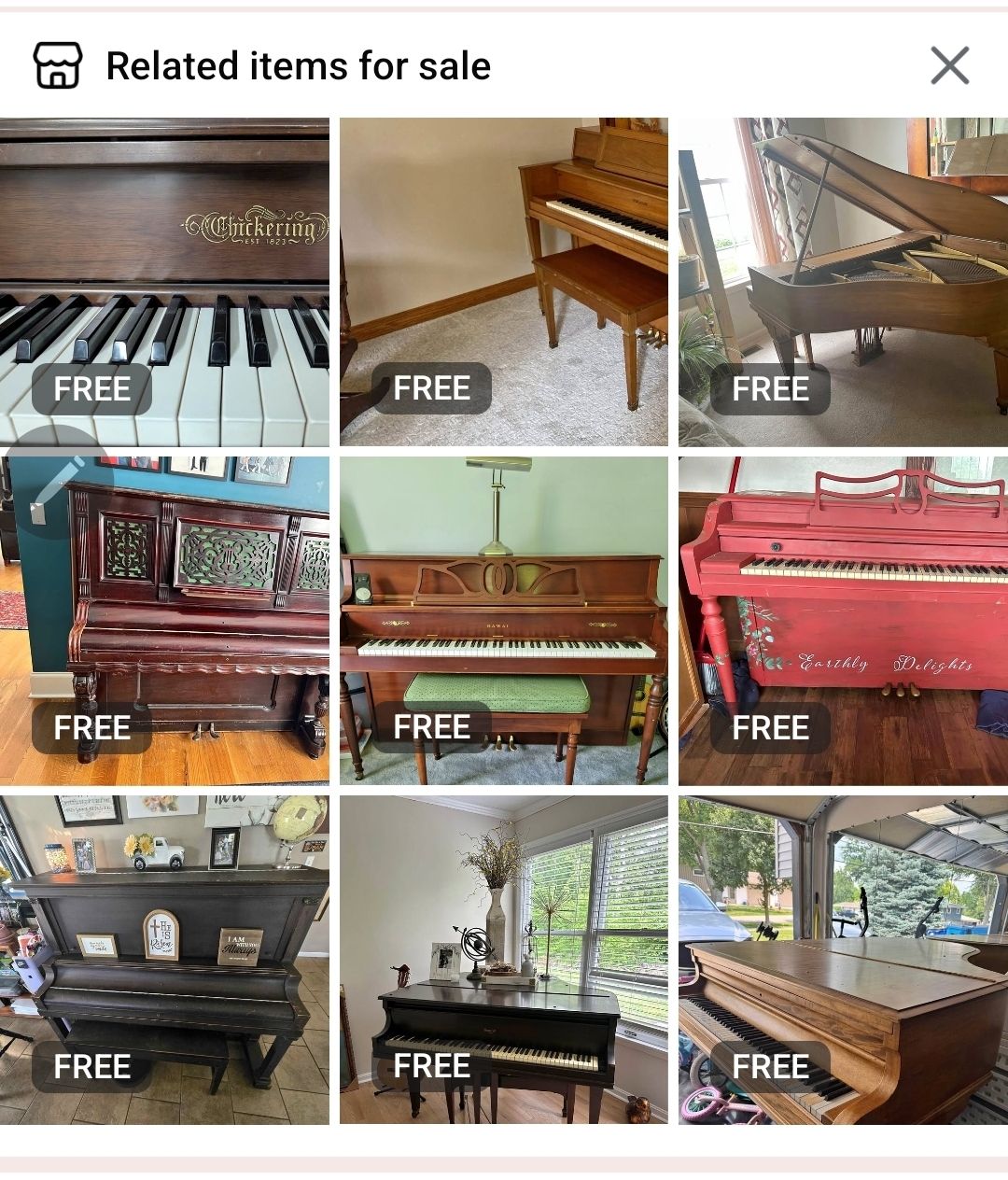
Check Facebook Marketplace or Craigslist right now. You'll find dozens of "free piano" listings in any major metro area. Free. People literally cannot give these instruments away. Even churches and schools don’t want your piano - they get offers all the time and have learned the hard way that a used piano can be an expensive problem.
Why? Because even free pianos cost money:
- Moving costs: $400-$700 to move the "free" piano to your home
- Unknown condition: That free piano probably needs tuning. Any savvy buyer would want to bring a tuner to have the piano inspected before purchase. Another $200, and possibly significant repairs.
- Whoops. Now you have to find a tuner! With us, the first tuning is discounted ($98 no matter where you live) and we have the tuners on hand.
- Maintenance commitment: You're inheriting someone else's maintenance problem
- Disposal risk: If the piano is in bad shape, you've just taken on an expensive disposal problem yourself
So even free pianos sit unclaimed.
The Home Sale Leftover Problem
We hear this story constantly: Someone sells their house and leaves the piano there. The buyers think it's a nice bonus until they realize it hasn't been maintained. Then they call us asking us to haul it away.
And they pay for that service.
Think about that. The piano went from a $15,000 purchase to something people pay to have removed. That's worse than zero value, that's negative value.
The Emotional Cost
Beyond the financial hit, there's an emotional element here that people don't anticipate. You spent $10,000 or $15,000 on this beautiful instrument. Maybe your daughter took lessons on it for three years. There are memories attached.
When you're trying to sell it for a fraction of what you paid and nobody wants it? It feels awful.
If you rent from PianoPiano, you skip all of this. When you're done with the piano, you call us, we schedule a pickup, and we take it away. No listing. No lowering the price week after week. No strangers coming to your home to inspect it. No guilt about an expensive purchase that didn't work out. And on the flip side, if you fall in love and want to own it, you can do that too.
The Numbers Don't Lie
In every scenario, purchasing costs significantly more than renting over a three-year period, even before accounting for the time and stress of reselling.
[IMAGE: Parent looking stressed while looking at a large piano in a living room, perhaps with moving boxes nearby. Captures the emotional burden. Alt text: "Homeowner dealing with the stress of an unwanted piano during a move"]
The Hidden Costs That Don't Show Up on a Spreadsheet
There are costs beyond dollars that purchase-focused pricing guides never mention.
 The Flexibility Cost
Life changes. You get a job offer in another city. You downsize to a smaller apartment or move to a bigger house. Your daughter quits piano lessons and wants to try guitar instead. The piano player in the house goes to college. (Which you also have to pay for.)
When you own a piano, all of these life changes become more complicated and expensive. You're stuck with a 500-pound decision.
When you rent, you give 30 days notice and we pick it up. Done.
The Commitment Anxiety Cost
Here's something we hear constantly: "What if my kid quits piano?"
It's a legitimate fear. Most children who start piano lessons don't stick with it long-term. Parents know this. So they're spending $10,000-$15,000 on an instrument their child might use for two to five years.
That's $5,000-$7,500 per year of use. That's not a good investment.
With rental, if your child quits, you return the piano. You're out maybe $2,000-$3,000 total for those two years. That's reasonable for an activity your child tried.
And here's the flip side: if your child turns out to be a virtuoso, you can upgrade. Start with an affordable console, switch to a professional upright as they advance, move to a baby grand when they're ready. Rental grows with them.
The Redecorating Cost
Want to change your living room aesthetic?
We offer custom-colored pianos in our KPOP™ series specifically because people care about how the instrument looks in their home. With rental, if you redecorate, you can exchange for a piano in a different finish. Try doing that when you own it.
Why Piano Rental Exists: Solving Real Problems
We watched customers struggle with instruments they couldn't sell. We fielded panicked calls from people who needed to move and didn't know what to do with their piano.
 The PianoPiano Rental Model
Here's how rental solves the ownership problems we've outlined:
No delivery surprise: Delivery and pickup are included in your first payment. We handle all the logistics, stairs, tight spaces, everything.
Maintenance included in the relationship: We request that you tune your rental piano every six months using our certified technicians. We remind you when it's time so you don’t have to keep track of it. Our tuning rates are always the lowest in your area because we’re able to offer volume work to our technicians. The piano stays in good condition, and you're never surprised by a maintenance bill.
Piano protection options: We offer a damage waiver for $12.50/month with a $1,000 deductible that covers complete loss, or you can add the piano to your homeowner's or renter's insurance. (Normal wear and tear isn't charged—we're talking about total loss due to fire or flood.)
Unlimited exchanges: Picked the wrong size piano? Does your child need an upgrade? Do you want a different finish? Exchange as often as you want. We charge a one-way delivery fee, and you can change your mind as often as you like. We won’t let you make a mistake!
Flexibility to end anytime: Give us 30 days notice and we pick up the piano. No trying to sell it. No strangers coming to your home. No disposal problem. Just done.
Rent-then-own option: This is not "rent to own." It's "rent, then buy if you want." You're not forced to make a purchase decision upfront. If you decide to buy after renting for a while, 100% of your rental payments during the first 12 months apply toward the purchase price. You get 12 more months to pay the remainder at 0% interest. Oh, and the purchase price is guaranteed at the time you rent and will never increase. So even if you rent for 10 years, your purchase price remains the same - at a traditional piano store the purchase price goes up every single year.
Quality guarantee: Every piano comes from the manufacturer or our refurbishing facility. Two-year warranty with an option to extend. You know exactly what you're getting, and you know where to find us--we’ve been here since 1975, and we aren’t going anywhere.
A Green Choice: Rental keeps pianos out of landfills. When you're done with a piano, we refurbish it and find it a new home—extending its life for generations instead of letting it become waste. Pianos are made from as many as 8 different kinds of wood, which means 8 trees per instrument. Rental means fewer pianos manufactured, less overseas shipping, and instruments that get used for decades instead of abandoned after a few years. Rental pianos get a second chance to make music.
See how our rental process works: Piano Rental Plans >>
Who Rental Is Really For
Everyone!
Our customers are professionals who understand the value of flexibility. They're families who want to try before committing $15,000. They’re conservatory students who are in town for only a few years. They're people who have owned pianos before and learned the hard way about depreciation and resale difficulty.
Smart people, who did the math.
Making Your Decision: Questions to Ask Yourself
Before you commit to purchasing a $5,000-$30,000 instrument, consider these questions honestly:
[IMAGE: Checklist or decision tree graphic helping readers evaluate purchase vs rental decision. Clean, helpful design. Alt text: "Piano purchase decision checklist"]
Commitment Questions
- How certain are you that you (or your child) will still be playing piano in three years?
- Have you owned a piano before, or is this your first one?
- Are you certain the piano you’re choosing will serve your needs for the rest of your life?
Practical Questions
- How long do you plan to stay in your current home?
- What happens if you need to move in two years?
- Do you think your next home will be the same size and have the same conditions like flights of stairs?
Financial Questions
- Have you budgeted for delivery ($400-$700)?
- Can you afford $500/year for maintenance?
- Are you prepared to lose 50-60% of your purchase price if you need to sell?
- Do you have time and patience to sell a piano on the private market?
Flexibility Questions
- What if you pick the wrong size, brand or color piano?
- What if your needs change as you progress (or as your child progresses)?
- How important is it to be able to walk away without financial loss if circumstances change?
An Honest Assessment
If you answer all of these without hesitation, you’re in great shape to purchase and maintain a piano in your space.
If you hesitated on more than half of those questions, rental is probably the smarter choice for you right now. You can always decide to buy later and use rental payments from the first 12 months towards purchase of the piano you’re renting or any other we have of equal or greater value. (Psst: we’ll even let you prorate your rental payments towards a less expensive model.)
Next Steps: Explore Your Options
Now you have the complete picture. The purchase price is real, but it's only about 60-70% of what you'll actually spend on piano ownership over three years.
Learn More About Specific Piano Types
Want to dive deeper into specific categories?
- Baby Grand Piano Cost: Try Before You Buy - Space requirements, delivery challenges, and when grands make sense
- Silent Piano Systems: How They Work & What They Cost - Technology breakdown, retrofit options, and NYC apartment solutions
- Upright Piano Prices: Entry, Mid-Range & Professional Tiers Explained - Detailed breakdown of quality differences you can hear and feel
Explore Rental Options
Ready to see what rental actually costs for specific instruments?
- Browse by brand: Yamaha | Young Chang | Weber
- See all rental inventory - 43 pianos available for immediate delivery
- Learn more about how it works - Pricing, terms, and rent-then-own details
Still Have Questions?
We get it. This is a significant decision. Check our Extended FAQ for answers to common questions about rental process, maintenance, exchanges, and more.
Or call us at (212) 586-9057 (East Coast) or (714) 805-8645 (West Coast). We've been doing this for 50 years, and we've probably talked to someone in your exact situation before.
A Final Thought
You want a piano in your home. You want to hear music drifting from the living room while you're making dinner. You want your kids to grow up with an instrument they can always return to. You want to sit down at the keys after a long day and lose yourself in something beautiful. That's what this is all about.
We've spent this guide talking about costs and logistics because those are the questions people ask when they're researching. But here's what we've learned in 50 years: the best piano is the one that actually makes it into your home and gets played.
We built PianoPiano around one idea—give people a way to have a piano free from the weight of a permanent decision. Start with a console, upgrade to a professional upright when you're ready, switch to a baby grand if you fall in love. Or rent for twenty years and never buy. Both paths are good.
If you eventually want to buy, your rental payments work toward that. If not, send us an email and we'll come pick it up. That’s it.
No sunk costs, no moving problems, no guilt. Just music in your home, for as long as you want it.
About This Guide: This pricing guide reflects current market rates and costs as of January 2026. Piano prices and associated costs vary by region, brand, and specific circumstances. All PianoPiano rental rates and product links are current as of publication. The total cost ownership calculations assume proper maintenance, average depreciation rates, and typical use cases over three years.